From Winds to Explosions: The Physics of Interacting Cool Giants
- Sponsor
- Department of Astronomy
- Speaker
- Professor Shazrene Mohamed
- Contact
- Daniel Franco
- danielf9@illinois.edu
- Phone
- 217-300-6769
- Views
- 58
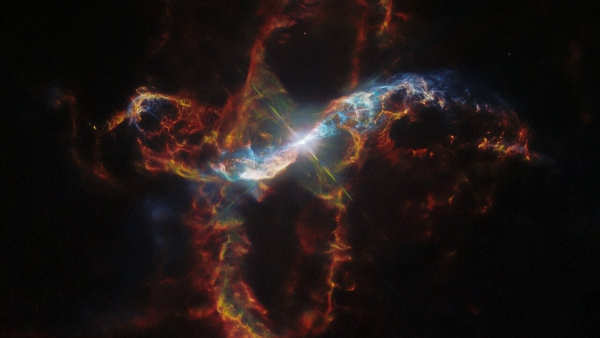
Rich in dust and heavy elements, the massive outflows of cool giant stars play a key role in the chemical evolution of galaxies and supply the raw material for planetary systems and life. Yet the origin of these outflows remains poorly understood. High-resolution observations have revealed highly complex circumstellar environments marked by spirals, shells, arcs, jets, and disks. The structures not only hold clues to the physical processes that drive and shape the outflows but are also important for understanding the mass-loss histories and final fates of these systems. Using advanced numerical codes with realistic microphysics, hydrodynamics, and radiative processes, we model these systems in full 3D, following matter from the stellar atmosphere through the circumstellar envelope to the interstellar medium. In this talk, I will focus on the impact of stellar and sub-stellar companions on cool giant outflows. I will discuss Wind Roche-Lobe Overflow (WRLOF), a mode of binary mass transfer that is efficient even in wide binaries and its implications for chemically peculiar stars, X-ray binaries, novae, and the progenitors of Type Ia supernovae. I will also show that companions as small as a few tens of Jupiter masses can sculpt the winds and enhance mass loss. On larger scales, bow shocks and detached shells form where the outflows collide with the interstellar medium. These structures subsequently affect the evolution of e.g., interacting supernovae, and the dust and gas that is ultimately returned to galaxies.